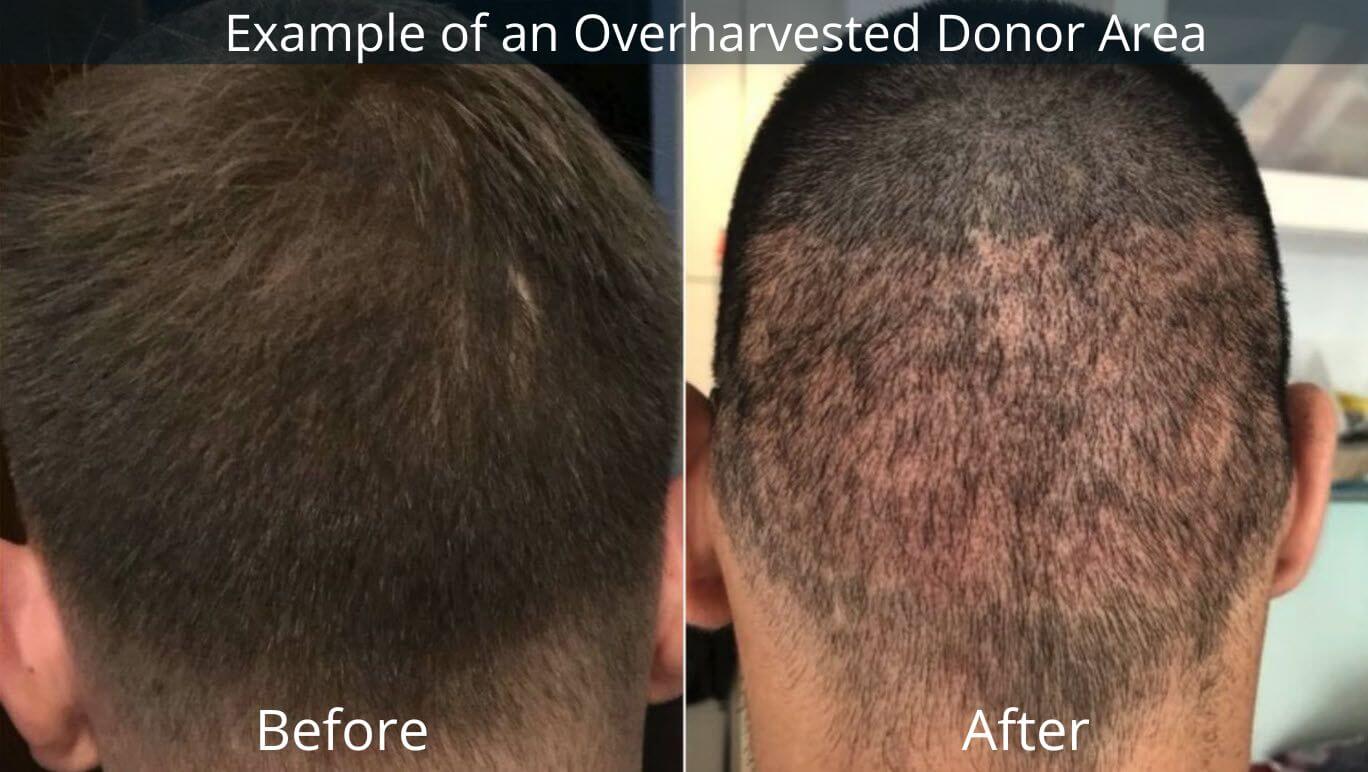
FUE hair transplant donor overharvesting is a common mistake that can be made during the procedure. This error overharvesting hair transplant can happen when Follicular Unit Extraction (FUE) surgeons harvest too many grafts on the back or sides of a patient’s scalp. This creates a thin, depleted appearance in the donor areas. In the recipient area, it may lead to the insertion of too many hairs or not enough.
Hair transplant donor overharvesting results from poor surgical planning and management. In a typical hair transplant procedure, grafts are harvested from the lower back and sides of the scalp.
When extracting hair from these donor regions on the head, surgeons need to set the goal of leaving these regions appearing untouched. This requires two considerations:
removing small amounts of hair diffusely, across wide areas, instead of completely extracting one zone before moving onto another.
harvesting an appropriate number of grafts to preserve the scalp donor area while producing a desirable form of coverage in the recipient area.
When Follicular Unit Extraction first became available, many providers were overzealous as they focused excessively on extractions over the final appearance of the donor region. They did not exercise much caution or foresight. As a result, FUE hair transplant donor overharvesting produced two types of mistakes.
patients who had an excessive number of hairs transplanted, with hairlines placed too close to the eyebrows
patients who remained significantly bald with a sparse, desolate form of coverage on top of their head
The use of head hair is appropriate for mild to moderate stages of male pattern baldness. However, when a patient reaches the severe phases – Norwood 6 and Norwood 7, the exclusive use of head hair becomes problematic. These forms of hair loss usually require around 10,000 grafts to create acceptable forms of coverage. Yet, the maximum number of grafts that can be harvested from the head (in mild to moderate cases of hair loss) is 8,000.
Using a Body Hair Transplant Donor Area
Dr. Umar recommends using both head and non-head donor areas to produce the donor pool supply for Norwood 6 and 7 patients. Body donor areas may include the beard regions on the face and neck. Other areas for consideration may include the abdomen, chest, and back. Non-head donor areas help provide the needed quantities of hair grafts that cannot be attained from the hair remaining on the scalp.
The use of body hair grafts expands upon the hair transplant donor area of the scalp. By using more specialized FUE hair transplant punches like Dr.UGraft™ technology, it is possible to safely harvest the large quantities of donor grafts needed to restore severely bald patients. Body hair appears to grow at certain sharp angles above the skin’s surface. But these angles change beneath the skin’s surface.
Basic, general FUE punches cannot follow these angulation changes without damaging the graft. The Dr.UGraft™ rotary punches focus on gripping the tissue around the graft during the scoring process rather than the hair angle to safely remove the hair follicle. This patented engineering provides a reliable mechanism for extracting large graft counts from body donor areas. These large quantities are necessary to produce the best cosmetic results on severely bald patients and even repair bad hair transplant results.
 Site Title